
Data Centers, the Conundrum
What are the Alternatives? Musk proposes building them in orbital satellites.

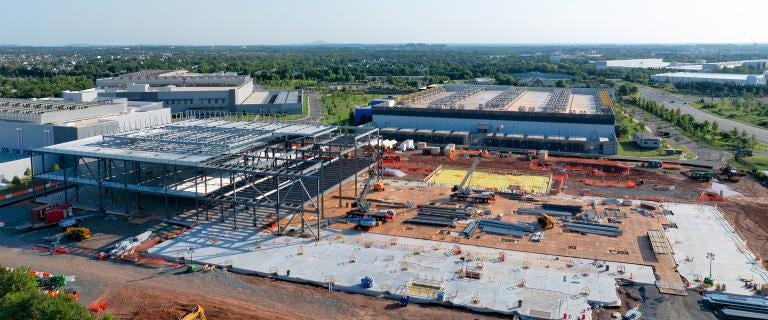
As AI fuels data center expansion, communities are pushing back. What’s driving the opposition, and what are the real environmental and economic trade-offs? YSE experts weigh in.
As proposals to build data centers to meet the computing demands of artificial intelligence grow, so too does the pushback. Cities including Denver, Minneapolis, and Seattle are considering municipal restrictions on data centers, and according to Data Center Watch, a research project from technology company 10a Labs, more than 140 local groups have managed to block or delay more than $60 billion in data center investments in roughly a year. The concerns around data centers are immediate and local: urban heat, water consumption, electricity grid strain, but the drivers are global and economic. Understanding the science, the political landscape, and the underlying economics is critical to understand how this technology will shape communities.
Karen Seto, the Frederick C. Hixon Professor of Geography and Urbanization Science and Director of the Hixon Center for Urban Sustainability, explains what data centers actually do to urban heat. Daniel Esty, the Hillhouse Professor of Environmental Law and Policy, maps the cross-spectrum opposition and what it reveals about how society should approach AI’s costs and benefits.
Kenneth Gillingham, the Grinstein Class of 1954 Professor of Environmental and Energy Economics, breaks down the economic and energy realities driving the data center boom, and Yuan Yao, the Manufacturer’s Association Professor of Industrial Ecology and Sustainable Systems, explains the environmental costs of data centers and what solutions exist to minimize their impact.
Q. How do data centers actually affect urban heat? What does the science show?
Seto: Because nearly all of the electricity consumed by a data center ends up as heat, servers and other equipment require continuous cooling. These cooling systems remove the heat generated by computing and release it into the surrounding environment as waste heat. Recent research conducted in Phoenix, Arizona, estimates that a large data center can emit waste heat comparable to that produced by tens or even hundreds of thousands of households. The latest science shows that this waste heat can increase surrounding land surface temperatures by as much as 16°F and raise air temperatures in nearby neighborhoods by up to 4°F. These effects have been observed as far as half a kilometer away, or about five city blocks!
While more research is needed, these findings suggest that data centers can worsen heat exposure in neighborhoods that are already impacted by the urban heat island effect. Given that cities are typically 1-7°F warmer than surrounding areas, additional warming from data center waste heat can further increase air conditioning energy demand and human health risks in nearby communities. In order to mitigate these impacts, cities and industry leaders should work together on better facility design and neighborhood cooling strategies, including parks and reflective surfaces.
Q. Communities are pushing back on data centers across the political spectrum. What are they actually opposing — and why?
Esty: Reactions to the growth of data centers represent something of a Rorschach Test — perhaps telling us more about the economic confidence of those offering opinions than anything else.
Every week, we see new AI-enabled tools emerging that might allow us to reconfigure our food, transport, building management, and energy systems for much greater efficiency and thus sustainability. AI also offers the potential to bring cutting-edge thinking and technologies to every corner of the globe at speed and scale, which might allow us to ramp up the global response to shared challenges such as climate change, biodiversity conservation, chemical exposures, and pollution.
But AI also poses significant risks related to growing electricity demand that could cause a spike in greenhouse gas emissions as well as air and water pollution if the new power requirements are met by fossil fuels rather than clean power generation and improved energy efficiency.
What has become evident is that society needs a more clear-eyed approach to the potential losses from AI as well as a strategy for sharing the benefits. Simply put, only with ongoing policy-guided investments and concerted effort can we be confident that AI will move society toward a sustainable future.
Q. What’s the actual economic and energy reality driving data center growth?
Gillingham: The main driver of data center expansion today is the race to train better AI models. In addition to training large language models, data centers are also used to run generative AI queries. They are also used simply to store all of the data that we all have in the cloud. But the primary driver of the growth really is generative AI.
Generative AI may offer valuable benefits to society, but large data centers consume massive amounts of electricity and water. Some large data centers under construction are slated to use 3 GW or more of peak electricity. This is more than 75 times Yale’s peak demand. We are beginning to see substantial anxiety about generative AI in the polls, as well as substantial pushback from some politicians. Regardless, energy policy will have to accommodate the first new growth in electricity demand in a couple of decades. Electricity prices are already rising, and they are likely to continue to increase in the near future. Higher electricity prices can help the adoption of renewables, but so far, the new electricity demand has largely been met with natural gas generation. This means increased emissions. We don’t know how many new data centers will be built, but it is clear already that the next few years will be a very dynamic time for electricity markets and energy policy.
Q. What are the real environmental impacts of data centers, and what solutions are there?
Yao: The environmental impacts of data centers are real, but they are also highly context-dependent. The most visible impact is electricity use, which can translate into greenhouse gas emissions depending on when and where the power is consumed. A data center located on a coal- or gas-heavy grid can have a very different carbon footprint from one using low-carbon electricity. Water use is another major concern, especially for cooling and for electricity generation upstream, and it matters greatly whether a facility is located in a water-stressed region.
A life-cycle perspective is important because impacts do not come only from day-to-day operations. Data centers also require servers, chips, cooling equipment, buildings, backup power systems, and grid infrastructure, all of which carry embodied environmental impacts from manufacturing, construction, and replacement.
The solutions that work best are not single fixes, and they may differ across locations, technologies, and operating models. Energy efficiency and improved cooling remain important, but efficiency gains can be offset if total demand grows rapidly. Clean electricity procurement is essential, but it should be evaluated by location and time, not just annual averages. More broadly, solutions need to consider siting and infrastructure decisions, operational strategies, and the full life cycle management of hardware and equipment. Transparent reporting and metrics that capture carbon, water, reliability, and life cycle environmental impacts together are also critical.
Bridget Shirvell is with Yale School of the Environment. This story is shared in cooperation with Yale School of the Environment.
A.I. is limited by energy and cooling capacity, and public acceptance.
Public acceptance of data centers has plummeted, with roughly 70% of Americans opposing the construction of new data centers near their communities. Driven by the artificial intelligence boom, the backlash focuses heavily on concerns about skyrocketing local energy bills, massive water consumption, noise pollution, and strained power grids. [1, 2, 3]
Data center projects are facing historic levels of local resistance, prompting communities and lawmakers to push back across multiple fronts: [1, 2]
High Rejection Rates: Only about 14% to 28% of Americans support data centers being built in their own communities. In early 2026, residents and local officials successfully delayed or blocked at least 75 proposed U.S. projects worth $130 billion. [1, 2, 3]
Legislative Action: State and local governments are pushing back aggressively. Over 170 communities have implemented moratoriums, and lawmakers in 14 states have introduced bills to limit or temporarily halt new data center developments. [1, 2]
The “Not In My Backyard” (NIMBY) Effect: Even though citizens generally acknowledge that data centers create short-term construction jobs and boost municipal tax revenue, these financial benefits are heavily outweighed by environmental and grid capacity worries. [1, 2]
Eroding Trust: Studies show that tech companies backing these projects are among the least trusted voices by the public, while utilities and independent environmental organizations retain far more credibility regarding grid impacts. [1]
You can explore comprehensive national survey data regarding this trend on the Pew Research Center or read the latest sentiment analysis reported by Gallup. [1, 2, 3]
If you are interested in exploring this topic further, let me know if you would like to:
Look into data center projects or moratoriums in specific states (like Michigan, New York, or California)
Analyze the specific environmental regulations being proposed to mitigate water and power usage
See how corporate tech giants are attempting to improve public relations and community outreach
Three-quarters of Americans say they’ve heard or read a lot (25%) or a little (50%) about data centers. The remaining 25% say they have heard nothing at all about them.
More Americans say data centers harm the environment, home energy costs, and people’s quality of life nearby than say they have a positive effect. Far more say data centers are mostly bad than good for the environment (39% vs. 4%), home energy costs (38% vs. 6%), and the quality of life for those nearby (30% vs. 6%).
In contrast, Americans are more likely to see positive than negative effects on local jobs and local tax revenue. More adults say data centers are mostly good than bad for local jobs (25% vs. 15%) and local tax revenue (23% vs. 12%). Still, Americans are less likely to express positive views of data centers’ impact in these areas than to express negative views of their effects on the environment, energy costs, and people’s quality of life nearby.
For many Americans, the jury’s still out. Around one-in-five Americans or more say they aren’t sure of data centers’ impact in each of the five areas we asked about. Others say these facilities have neither a positive nor a negative impact in each area, nor have they heard about data centers at all.
Elon speaks in ‘Elonese,’ a typical grandiose, larger-than-life solution to a world problem. Launching a million solar-powered data centers would require enormous energy in itself.