
More DHS bungling
How long will this go on?

TIMES exclusive
Homeland Security Paid $464 Million for Airplanes. Then It Parked Them.
The agency used a no-bid contract to buy 10 used jets, saying they were urgently needed for deportation flights. But the fleet has largely sat idle for months.
By David A. FahrentholdAndrea FullerJulie TateNicholas Nehamas, and Hamed Aleaziz
To understand this Department of Homeland Security contract, the reporters talked to people with knowledge of it and examined flight tracking data, contracting records, and internal documents.
Aug. 13, 2026, 5:03 a.m. ET
Starting last fall, the Department of Homeland Security spent $464 million on a no-bid contract to buy 10 used airplanes from a firm in Northern Virginia.
That was an enormous price tag, but the department said it had no time to consider other offers. The planes were needed urgently for deportation flights.
But since then, the department has barely used this new fleet — for deportations, or anything else.
Three of the aircraft are luxury business jets. Just months after acquiring them, the department sought to loan or lease two to other agencies, including one for the use of FBI Director Kash Patel, according to a letter to the department sent Wednesday by top Democrats on the Senate Appropriations Committee.
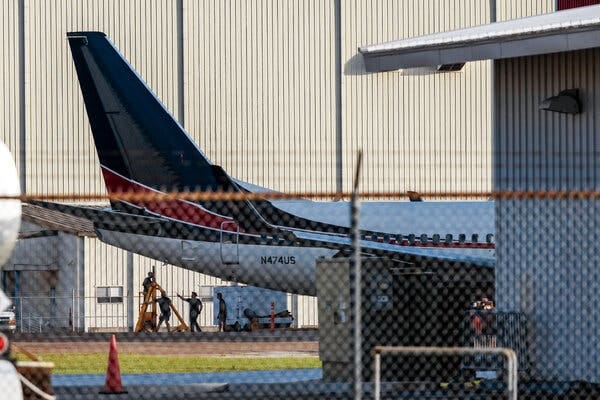
The other seven are older Boeing 737 passenger jets, which the government has left parked at an airport in Lake Charles, La., for months at a time. An internal government document, obtained by The New York Times, said the agency did not have the staff necessary to operate them.
Advertisement
The acquisitions were part of a surge of rushed contracts handed out recently by the Department of Homeland Security, which has repeatedly used the need for “urgency” to bypass regular contracting procedures. The idled planes highlight the risks of that approach. The agency rushed headlong to spend nearly half a billion dollars, only to end up with planes it did not fly.
The contract also illuminated a broader trend within the second Trump administration: no-bid contracts awarded to people with connections to Mr. Trump or his cabinet secretaries. The company that received this contract, Daedalus Aviation Corporation, is led by a chairman who had donated to a political committee supporting the previous Homeland Security Secretary, Kristi Noem.
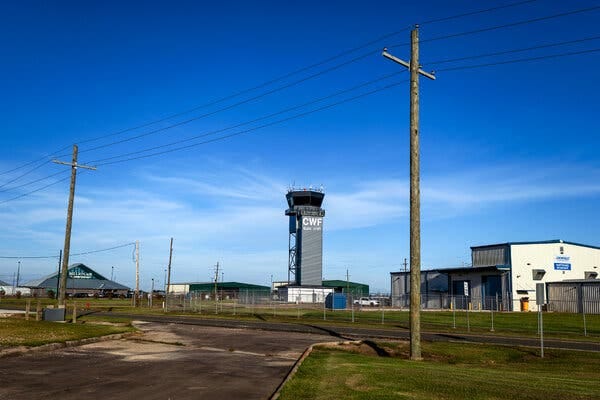
Flight records show that seven of the planes purchased by the Department of Homeland Security have largely sat for months at a small airport in Lake Charles, LA.Credit...Kathleen Flynn for The New York Times
The department’s Immigration and Customs Enforcement agency has long outsourced its deportation flights by chartering planes from private companies. It also uses military and Coast Guard aircraft. Because of that, former immigration officials said there seemed to be little need for the department to take on the expense of buying and maintaining a significant number of its own aircraft.
“If you asked me to write a list of the things ICE needed to increase the number of deportations, buying its own fleet of airplanes would absolutely not make the top ten,” said John Sandweg, a former acting director of ICE during the Obama administration.
In a written statement, the Department of Homeland Security sought to shift responsibility for the contract to Ms. Noem. President Trump fired her in March and appointed Markwayne Mullin, a Republican Senator from Oklahoma, as secretary.
“The contract for Daedalus was made and approved by department leadership before Secretary Mullin was sworn in,” the department said in a statement. The agency said it “reserves the right to adjust course in an environment with evolving requirements and demands.”
A spokeswoman for Ms. Noem sought to place the responsibility on Mr. Mullin instead, saying the purchase was “finalized” under his leadership.
Contracting records show that the size of the contract increased by $303 million on the day that Mr. Mullin was sworn in as secretary.
The agency said that the idle 737 passenger jets had been undergoing maintenance checks, and that there were plans for two of them to begin deportation flights later this month.
The situation with the planes was reminiscent of the department’s about-face on a plan to acquire warehouses to hold detainees. The department spent heavily on those when Ms. Noem was secretary, but reversed itself just months later under Mr. Mullin. The department is now giving away or selling seven warehouses that it bought for more than $700 million.
A letter sent to the department Wednesday by Democratic senators Patty Murray of Washington and Christopher Murphy of Connecticut, who sit on the Senate Appropriations Committee, said Homeland Security officials had already conceded to the committee that most of the planes would not be used for deportations.
“The American people deserve a full accounting of this gross misuse of their tax dollars,” the letter, which was reviewed by The Times, said.
The senators asked for details about the purchase price of each plane and how they would be used.
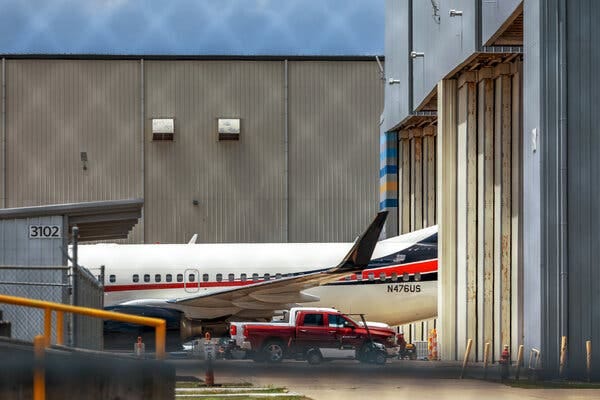
The agency said that the idle 737 passenger jets had been undergoing maintenance checks. Credit...Kathleen Flynn for The New York Times
Federal law generally requires government agencies to seek competing bids before awarding a contract, to ensure taxpayers get the best deal. But the department sidestepped that requirement for the plane’s contract by invoking an exemption for cases of “unusual and compelling urgency.”
That exemption can be used only when delaying the contract would result in “serious injury, financial or other,” to the government. Historically, it has been used during natural disasters, war, and the coronavirus pandemic.
The department declined to answer questions about what serious injury it was trying to prevent. Contracting regulations require agencies to publish the rationales for no-bid contracts, but the department refused to release this one, saying it “would compromise national security or create other security risks.”
The department has invoked the urgency exemption to justify more than $29 billion in spending across about 500 contracts awarded during Mr. Trump’s second term, according to an analysis of federal data by The Times. Much of that total came from border wall spending. Urgency claims were also used to justify projects like the $220 million in media contracts awarded to firms tied to Ms. Noem and her allies, scrutiny over which contributed to her ouster.
The exemption accounts for nearly two-thirds of the $34 billion that the department has spent on contracts signed in 2026. That’s up sharply from past years. In 2025, the figure was about one-quarter. In 2024, it was less than 1 percent.