
The Perfect Storm: Final Report
On a busy air corridor over the Potomac River, the Inevitable finally occurred

US admits failures in deadly mid-air crash at DC’s Reagan National Airport
ABC VIDEO NEWS
Iheart news reports:
The U.S. government has acknowledged its role in the deadly midair collision that occurred on January 29 between American Eagle Flight 5342 and a U.S. Army Black Hawk helicopter. The crash, which took place over the Potomac River as the passenger jet was approaching Ronald Reagan Washington National Airport, resulted in the deaths of all 67 people aboard the two aircraft.
In a court filing on Wednesday (December 17), the Department of Justice admitted that both the air traffic controller and the Army helicopter pilots failed to maintain necessary safety protocols. The controller violated visual separation procedures, while the helicopter pilots did not maintain vigilance to avoid the jet. The crash has been described as the worst air disaster in the U.S. since 2001.
The Justice Department acknowledged that the Federal Aviation Administration (FAA) and Army were partly responsible for the collision, but also noted that American Airlines and its regional partner, PSA Airlines, may share some liability. American Airlines has filed a motion to dismiss the lawsuit, arguing that the legal recourse should be against the U.S. government.
The National Transportation Safety Board (NTSB) is leading the investigation and plans to release a report on the crash’s cause early next year. Preliminary findings indicate that the helicopter was flying above the altitude limit and that the FAA had failed to address safety risks in the area, despite numerous near-misses in recent years. The NTSB has also raised concerns about the helicopter crew’s use of night-vision goggles, which may have impaired their ability to spot the jet.
The NTSB’s final report is expected to provide further insights into the crash’s contributing factors.
Deadly DC plane crash was years in the making, air traffic manager tells NTSB
The deadly mid-air collision at Reagan Airport in January was years in the making, the operations manager of the DCA air traffic control tower on the night of the accident told the National Transportation Safety Board on Friday.
“I don’t think this accident occurred that night,” Clark Allen, the operations manager, said at the investigative hearing. “I think it happened years before we’ve talked about, you know, resources, whether they were available or unavailable at certain time frames, folks being listened to or not being listened to at certain times. This was not that evening. It was a combination over many years that I think that built up to that evening.”
The NTSB concluded three days of hearings late Friday, during which the agency’s investigators questioned officials from the Federal Aviation Administration, U.S. Army, American Airlines regional subsidiary PSA Airlines and other parties over January’s mid-air collision between an American Airlines regional jet and an Army Black Hawk helicopter over Washington, D.C., that killed 67 people.
It was the nation’s first major commercial airline crash since 2009.
During the hearings, the NTSB was told that the Army helicopter never heard the command from the air traffic controller to “pass behind the CRJ” as the transmission was stepped on. It was also revealed that the plane’s pilots were not warned by the controller that there was a helicopter nearby or cleared to fly near the helicopter.
During the hearings, the NTSB was told that the Army helicopter never heard the command from the air traffic controller to “pass behind the CRJ” as the transmission was stepped on. It was also revealed that the plane’s pilots were not warned by the controller that there was a helicopter nearby or cleared to fly near the helicopter.
NTSB Chairwoman Jennifer Homendy also called out the FAA for not sharing a full list of who was working in the control tower the night of the crash until July 6, months after the accident.
Pilots likely didn’t know how high they were flying
The NTSB’s investigation found discrepancies in the altitude data shown on radio and barometric altimeters on Army helicopters after conducting test flights following January’s accident.
It is likely that the helicopter crew did not know their true altitude due to notoriously faulty altimeters inside this series of Black Hawks, according to the investigation. At their closest points, helicopters and planes flew within 75 feet of each other near DCA, an astonishingly close number. During the hearings, the NTSB was told Army Black Hawks can often have wrong readings and a margin of error of +-200 feet.
“I am concerned there is a possibility that what the crew saw was very different than what the true altitude was. We did testing in May that shows concerns with the altimeters, the barometric altimeters on the 60 Lima. So we are concerned, and it’s something we have to continue to investigate how significant is 100 feet in this circumstance,” Homendy told reporters on Wednesday.
Army officials told the NTSB investigators that they plan to inform other military aviation officials of the altitude discrepancy by September, but NTSB board member Todd Inman criticized this for a lack of urgency. he Army officials said they are also addressing it by mentioning it in the public testimony.
“I hope every Army aviator is not having to watch the NTSB.gov livestream to figure out if there’s a discrepancy in their altitudes and planes that are flying around,” Inman said.
Disconnect between DCA controllers and FAA leadership
NTSB investigators and board members noted that there seems to be a “disconnect” between the information they are getting from the FAA officials versus what the employees have shared with them during the interviews.
“What we’re trying to understand is where the disconnect is because what we have is for example, reports from controllers today that are saying there were 10-15 loss of separation events since the accident,” Homendy said.
Tension in the tower
Chair Homendy noted air traffic controllers crying during interviews with investigators following the crash, adding the controller whose voice is heard talking to the doomed aircraft has not returned to work. Tensions have been so high in the tower following the crash, a shouting match turned into a fist fight this spring, ending with a controller being arrested.
Some employees say they feared getting transferred or fired if concerns were brought up to their superiors.
“I hundred percent agree with you. There definitely seems to be some barrier in communication where the people that impacts it the most are not hearing the things that the FAA is moving forward on and that needs to be addressed. I agree,” said Franklin McIntosh, acting chief operating officer of the Air Traffic Organization -- the operation arm of the FAA.
“I wholeheartedly agree and I will commit to you and everyone on the board in the panel that I will start working this immediately to make sure whatever those barriers are occurring, that it stops,” McIntosh said. “Clearly someone in the facility doesn’t feel like they’re getting the help that they should be getting and quite honestly if that word’s not getting down, then we need to do a better job in breaking through whatever that barrier is.”
he FAA has pushed back on claims of employees being removed or transferred out of the tower as a result of the collision.
“So we didn’t remove anybody as a result of an accident,” said Nick Fuller, acting deputy chief operating officer with the Air Traffic Organization.
Recent Stories from ABC News
Homendy challenged that assertion saying, “I think many would disagree, since it was done pretty immediately. Also the NTSB had to weigh in several times to get people help in the tower.”
NTSB investigators also pressed FAA officials over controllers who manage DCA airspace feeling pressured to “make it work” due to the large volume of aircraft in the airspace near the airport.
“We have many non-standard tools that we use in order to be able to bring a significant amount of airplanes into DCA, “ said Bryan Lehman, air traffic manager at the Potomac Terminal Radar Approach Control, which manages air traffic control in the region, while also adding that they do take “pride in it,” but that it gets too much after a certain point.
Lehman also testified at the hearing that controllers sent a memo to their superiors in 2023 requesting a lower arrival rate for airplanes, but the concerns were dismissed and Congress approved more flights for DCA.
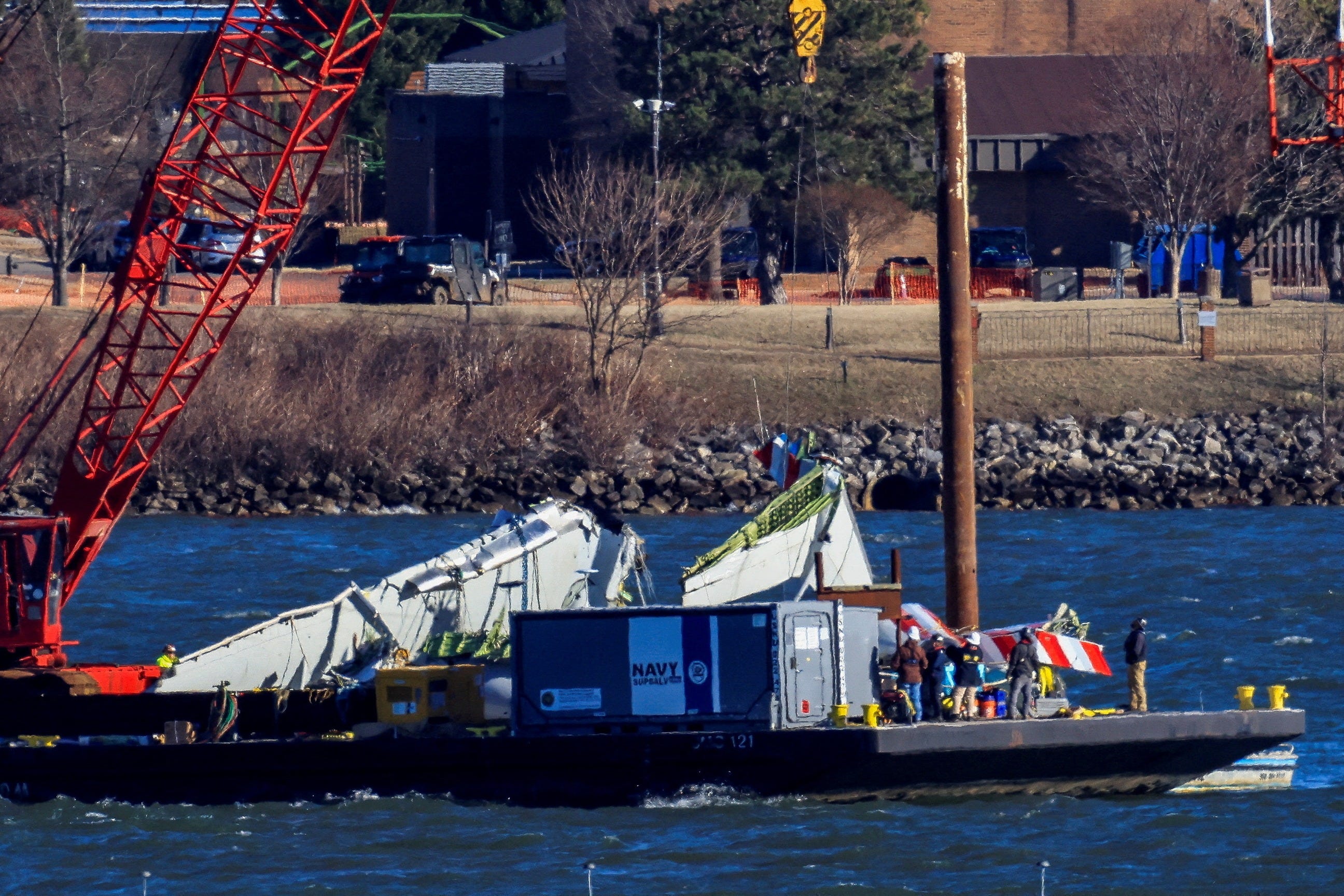
Eduardo Munoz/Reuters
ADSB policy for Army
Despite calls from lawmakers and the NTSB for mandated Automatic Dependent Surveillance–Broadcast (ADSB) -- technology that makes the aircraft more visible to the tower, other aircraft and the public -- on all aircraft, including military aircraft, it remains a point of hesitation for the Army.
All aircraft flying over 18,000 feet are required to have ADSB but certain aircraft, including military aircraft, are exempt from transmitting ADSB location when flying for security reasons.
“I’m pretty sure most people are aware of the fact that it’s inherently open source,” Army Lt. Col. Paul Flanigen told the hearing panel on Friday. “It has some spoofing vulnerabilities which make it non-conducive for those sensitive missions, which not just the army, but all of DOD has to operate on.”
As previously reported by ABC News, the helicopter involved in the accident was not transmitting ADSB out, meaning it wasn’t transmitting its location for other aircraft nearby to see where it was.
A Traffic Alert and Collision Avoidance System (TCAS) -- which detects other aircraft in close proximity -- was also not installed in the helicopter, according to the investigation.
The NTSB made a recommendation nearly two decades ago asking the FAA to require ADSB on all aircraft but it was not implemented. The point was brought up again during the hearings.
MORE: FAA administrator: ‘Clearly, something was missed’ that led to DC plane crash
“Does the FAA right now support requiring any newly manufactured aircraft registered in the U.S. be equipped with ADSB in?” Homendy asked.
McIntosh said yes and showed support towards requiring aircraft to be equipped with ADSB out as well.
Experts have said it’s more effective when an aircraft is equipped with both ADSB in and out so they can transmit their location and also receive the location of other aircraft in its near proximity.
A bill in Congress titled the “Rotor Act” was introduced earlier this week by Sen. Ted Cruz, which would require all aircraft, including military aircraft, to transmit ADSB location when flying. Notably, the newly appointed FAA Administrator Bryan Bedford and Transportation Secretary Sean Duffy were present at the news conference and showed their support towards the legislation.
The NTSB’s investigation into the cause of the accident continues and a final report is expected by January 2026.
“We do this to improve safety certainly but we all do this with each of you in mind and your loved ones that were lost tragically with you in mind not just on the CRJ but also PAT 25 so we will continue on and hope to complete this investigation within a year,” Homendy said in her closing remarks on Friday.
Acting Federal Aviation Administrator Chris Rocheleau admitted Thursday that “something was missed” regarding the devastating midair collision between an American Airlines plane and an Army helicopter that killed everyone on board both aircraft.
The National Transportation Safety Board said all of the data that shows the regular near misses and close proximity events at Ronald Reagan Washington National Airport (DCA) was publicly available data.
“Between October 2021 and December 2024 there were over 15,000 close proximity events between commercial aircraft and helicopters at DCA,” NTSB Chairman Jennifer Homendy said as she and Rocheleau testified before the Senate Commerce Subcommittee on Aviation, Space and Innovation.
The crash happened on the night of Jan. 29 when the PSA Airlines Bombardier CRJ700 regional jet with 64 people on board was about to land at Reagan. The three soldiers in the helicopter were conducting an annual training flight and night vision goggle check at the time of the collision.
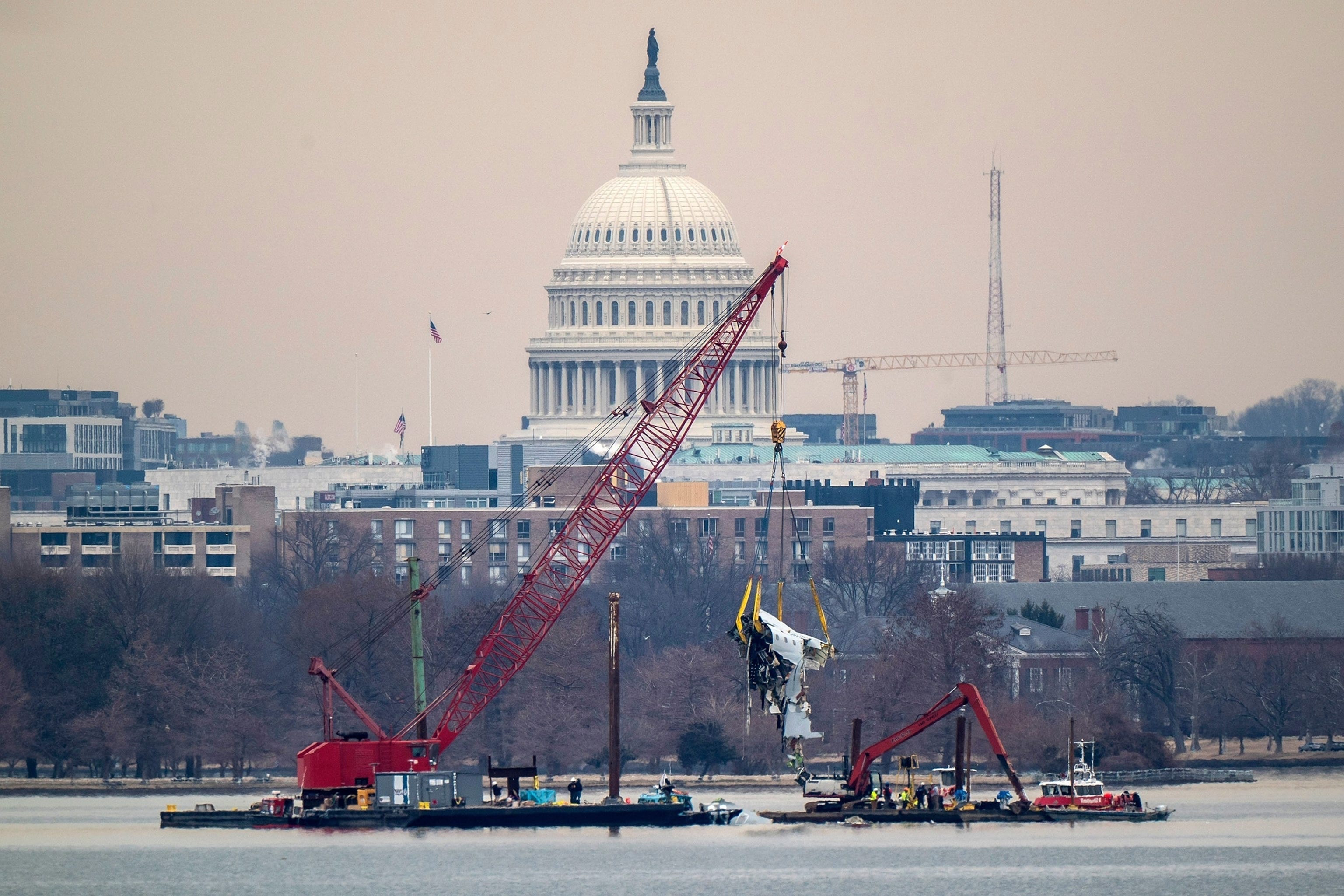
Jabin Botsford/The Washington Post via Getty Images
MORE: Search for 4 missing US soldiers now a recovery mission: Lithuanian minister of defense
Rocheleau faced tough questioning from senators Thursday over the lack of action taken by the FAA that could have prevented the crash based on the data available to the agency.
Recent Stories from ABC News

00:05
02:00
Read More
“Something was missed at the DCA crash. I take that seriously. I take that on myself,” Rocheleau said at the hearing. “I returned to the FAA just two months ago and I care about the National Airspace System for safety and the workforce. I’m dedicated to continuing that work, and I will continue to review what I mentioned before with respect to the hot spots, working closely with NTSB to learn what happened here and to make sure it never happens again.”
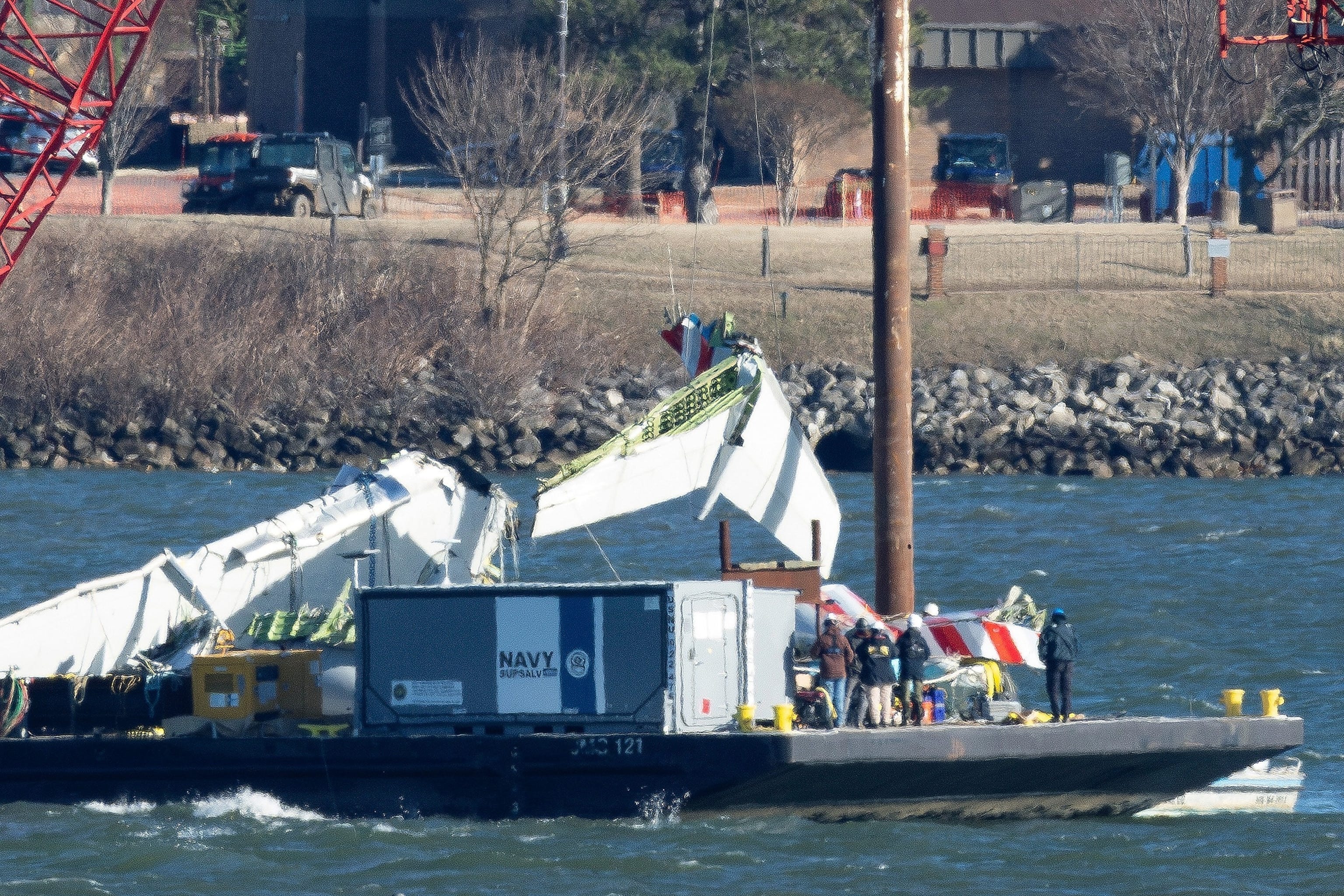
Kayla Bartkowski/Getty Images
The FAA said it is now using AI and machine learning to evaluate all the data that comes in showing potential issues in U.S. airspace.
Rocheleau also announced that, effective immediately, almost all aircraft operating around Reagan and downtown D.C. must have their ADS-B Out aviation surveillance technology on -- with the exception of presidential helicopters or other high security sensitive missions. Helicopters like the one that crashed on Jan. 29 are now required to broadcast their position using ADS-B Out technology.
The NTSB also said it’s looking at the Army’s 12th Aviation Battalion’s fleet of helicopters for installation programming and potential for equipment malfunction.
Homendy said there were 16 Lima models of Black Hawk in the fleet, including the helicopter involved in the crash. Eight had stopped transmitting ADS-B Out sometime between May and November 2023. Homendy said the NTSB did not know why they had stopped.
Senators pressed Army Brig. Gen. Matthew Braman on the Army helicopters operating in the DCA airspace without transmitting ADS-B Out data, leading to a fiery discussion between committee chair Sen. Ted Cruz, R-Texas, and Braman, with Cruz demanding the Army release the memo to the committee within the next 24 hours.
“The Army has a memo August 9, 2024 entitled ADS-B Out Off Operations in the National Airspace. My staff requested that memo from you, and my understanding is your team declined to provide it,” Cruz said. “That is also unacceptable. I want to ask you at this hearing, will you commit to providing that memo to this committee?”
Braman said he will look into if the memo can be released to the committee.
After Thursday’s hearing, Homendy told reporters that the failure of oversight is not just on the FAA, but on the Army, as well.
Thursday's hearing also revealed that the false alarms that told pilots they were on a collision course with another plane while on approach to Reagan Airport earlier this month were caused by the Secret Service and the Navy improperly testing counter-drone technology, according to an exchange between Cruz and Rocheleau. The testing was being done on the same spectrum that the Traffic Collision Avoidance System in the cockpit uses. Cruz said the Secret Service and the Navy were warned not to use the same spectrum before the false alarm incidents.
The NTSB hopes to complete the investigation into the Reagan crash within a year, Homendy said at Thursday’s hearing, noting that divers are still working to recover any remaining wreckage in the Potomac River.
The NTSB will interview the FAA cartographers about the mapping of the route around Reagan; Homendy said there was “virtually no margin of error” in the helicopter routes used around the airport.
Earlier this month, the NTSB called for immediate changes at Reagan, saying the current helicopter routes around the busy airport “pose an intolerable risk to aviation safety.”
The NTSB recommended permanently banning helicopter operations near Reagan when runways 15 and 33 are in use and designating an alternative helicopter route for pilots. Transportation Secretary Sean Duffy quickly said the Department of Transportation would follow the NTSB’s recommendations.